The Most Beautiful Neighborhoods in Charleston — and What Makes Each One Feel Different
Ask anyone who has been to Charleston what the city and its most beautiful neighborhoods looks like, and you’ll hear the same handful of images: pastel façades on a narrow street, a white steeple rising over the rooftops, palmettos leaning against old brick, a glimpse of garden through a wrought-iron gate. All of it is true. What the postcard version leaves out is that those details don’t appear the same way everywhere — and the differences are where Charleston gets genuinely interesting.
Each of the city’s historic neighborhoods represents a different chapter in its development and a different expression of its beauty. South of Broad is grand, quiet, and half-hidden. The French Quarter compresses three centuries of architecture into a few dense blocks. Harleston Village stretches out, leafy and residential. And on the upper peninsula, neighborhoods laid out in the early twentieth century trade formality for porches, bungalows, and oak canopy. Charleston’s preservation system was built around exactly this idea: what gives each neighborhood its character isn’t any single landmark, but the way architecture, landscaping, building forms, and street rhythm combine — and that combination changes as you move across the peninsula.
These are seven of Charleston’s most beautiful neighborhoods, what makes each one feel different, and the details worth noticing as you walk them.
Charleston’s Most Beautiful Neighborhoods at a Glance
| Neighborhood | Overall Feeling | Visual Signature |
|---|---|---|
| South of Broad | Grand, quiet, and deeply established | Formal homes, hidden gardens, ironwork, and waterfront streets |
| French Quarter | Historic, textured, and atmospheric | Narrow streets, pastel façades, churches, and cobblestones |
| Harleston Village | Leafy, residential, and elegant | Broad streets, historic homes, gardens, and Colonial Lake |
| Ansonborough | Refined and carefully preserved | Restored townhouses, piazzas, and intimate streets |
| Cannonborough-Elliotborough | Creative, colorful, and evolving | Charleston single houses, local businesses, and layered streetscapes |
| Hampton Park Terrace | Relaxed and neighborly | Deep porches, Craftsman homes, cottages, and mature trees |
| Wagener Terrace | Casual, local, and quietly coastal | Brick bungalows, oak-lined streets, and less formal architecture |
There’s no “best” neighborhood on this list. Each offers a different version of Charleston — the useful question is which version you’re looking for.
1. South of Broad: Charleston at Its Most Iconic
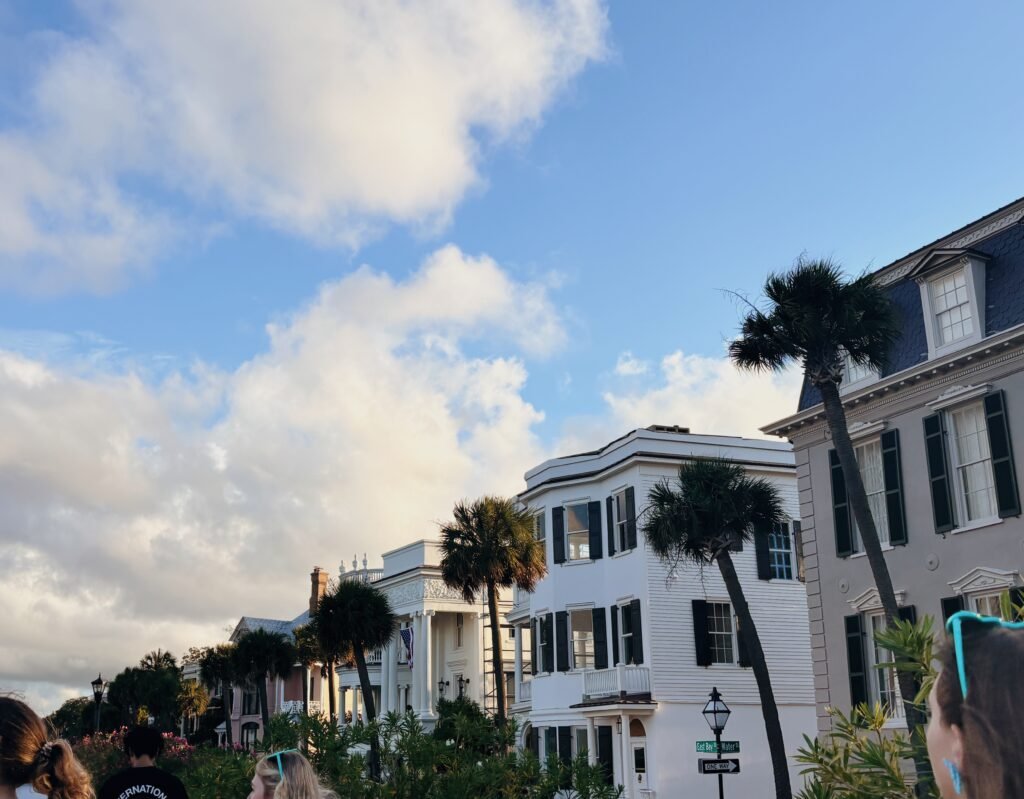
If a photograph of Charleston has ever made you pause, there’s a good chance it was taken South of Broad. This is the neighborhood at the very tip of the peninsula — the grand residences, the shaded streets, the famous gates, the promenade along the Battery — and it remains almost entirely residential, which is a large part of why it feels the way it does. It remains one of Charleston’s most celebrated residential neighborhoods, and after an hour on foot it’s hard to argue with its reputation.
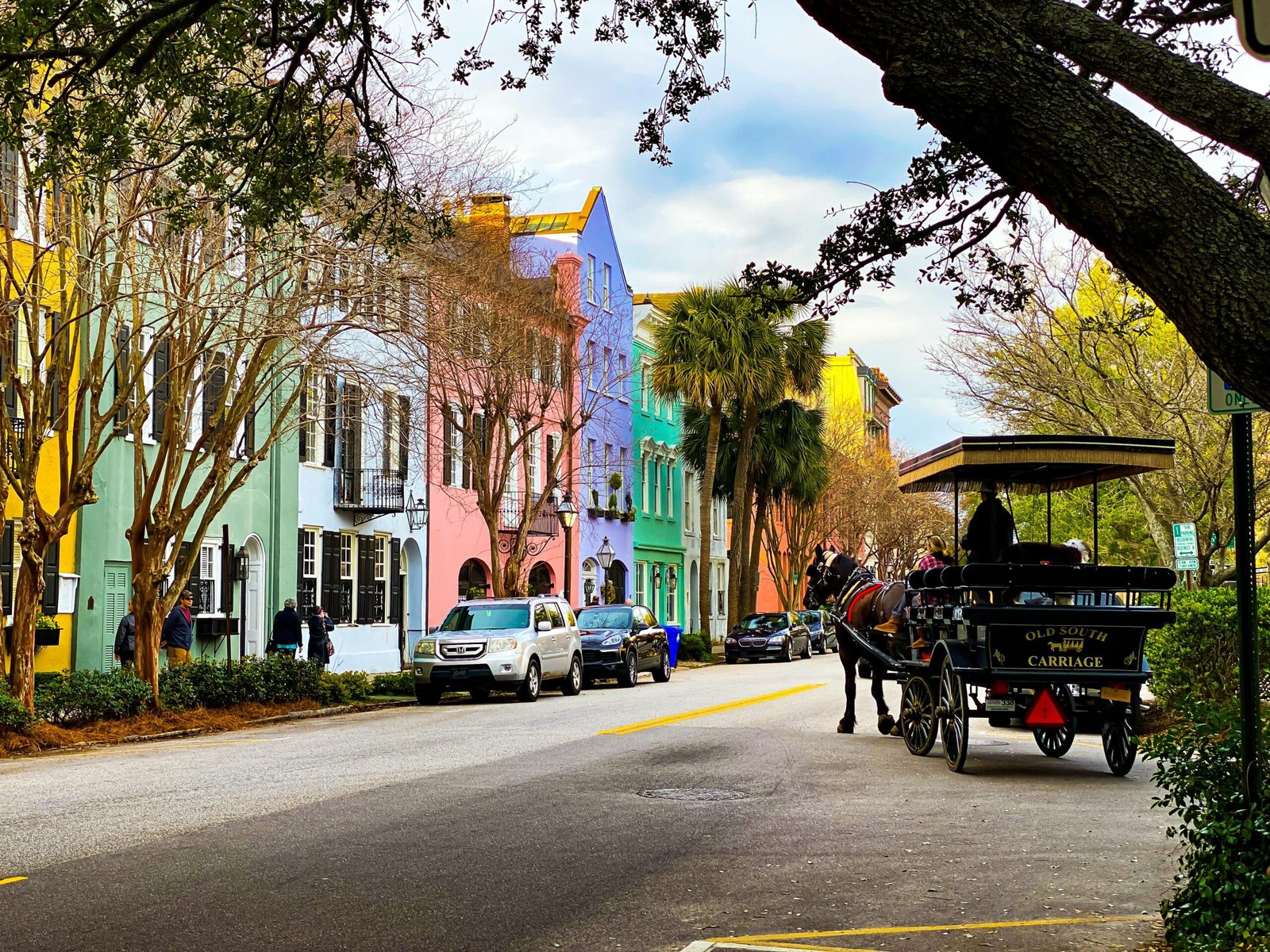
What surprises first-time visitors is how quiet it is. The Battery, White Point Garden, and Rainbow Row draw a steady stream of admirers, yet turn one corner inland and the crowds simply stop. A few blocks from some of the most photographed houses in the South, you can stand in the middle of the street at midday and hear little more than palmetto fronds and a distant church bell. Grand mansions sit beside smaller historic homes; garden walls and iron gates conceal as much as they reveal. Much of South of Broad’s beauty is deliberately withheld — glimpsed through a gate, over a wall, down a side path — which makes walking it feel less like sightseeing and more like being let in on something.
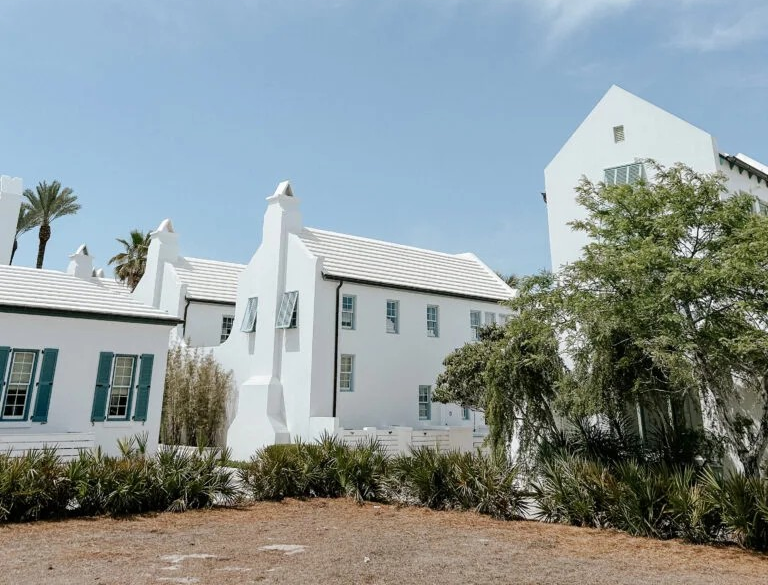
Notice, too, how the architecture answers the climate. Piazzas stack along the south and west sides of houses to catch the harbor breeze; tall windows and deep roof shade did the work air-conditioning would later take over. It’s the same lesson that makes 30A’s beach houses feel so different from ordinary construction: the most beautiful homes are usually the ones designed in honest conversation with their setting.
Look closely at the ironwork and gate details, piazza ceilings — often painted haint blue — side gardens, weathered brick paths, and the way homes angle themselves toward the water and the wind.
South of Broad’s beauty isn’t decorative. It’s cumulative — architecture, trees, gardens, weathering, and generations of stubborn preservation, layered until the whole neighborhood reads as a single composition.
2. The French Quarter: Charleston in Its Most Concentrated Form
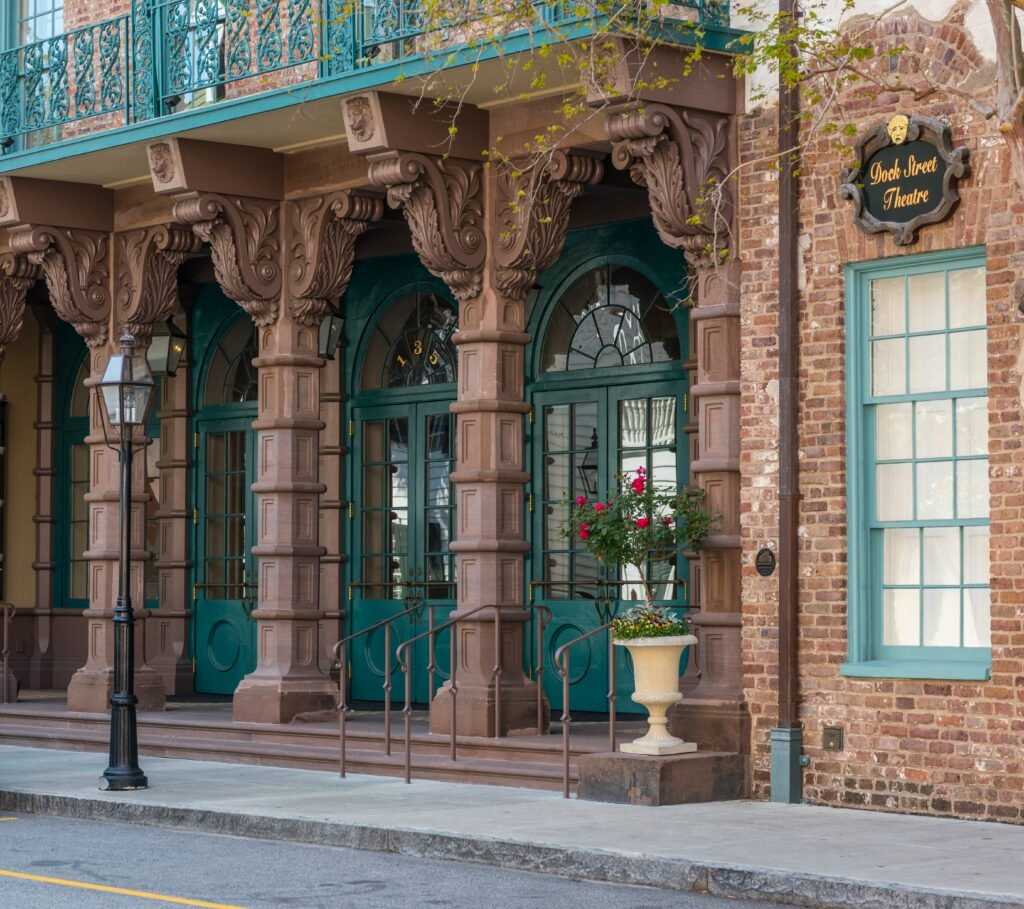
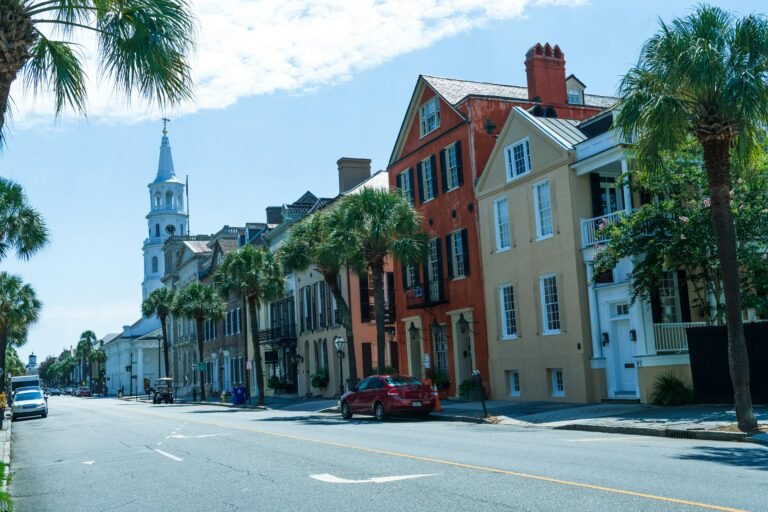
Walk a few blocks north and the peninsula changes register. The French Quarter — a National Register historic district — is where the city feels most compressed: churches, galleries, restored commercial buildings, and residences pressed together along narrow streets, some still paved in cobblestone. This is also where Charleston earns its “Holy City” nickname most visibly. St. Philip’s steeple rises directly over Church Street, the French Huguenot Church sits in Gothic Revival pink a block away, and the bells genuinely structure the day.
The French Quarter has no shortage of recognizable landmarks, but treating any one of them as the whole story sells the neighborhood short. Its real beauty is contrast held at close range. A working church stands a few doors from a gallery; eighteenth-century masonry shares a block with restored storefronts; a steeple appears at the end of nearly every street. Where South of Broad conceals, the French Quarter layers everything in plain view.
Because the blocks are short and the buildings close, the district rewards slow walking more than any itinerary could. The texture changes every few steps — stucco to brick to weathered shutters — and the light moves through the narrow streets in a way photographers chase all day. Skip the checklist and simply wander; the neighborhood is small enough that you can’t really get it wrong.
The French Quarter’s beauty comes from density: sacred, residential, civic, and commercial architecture coexisting within a handful of blocks, each one sharpening the others by proximity.
3. Harleston Village: Quiet Elegance Around Colonial Lake
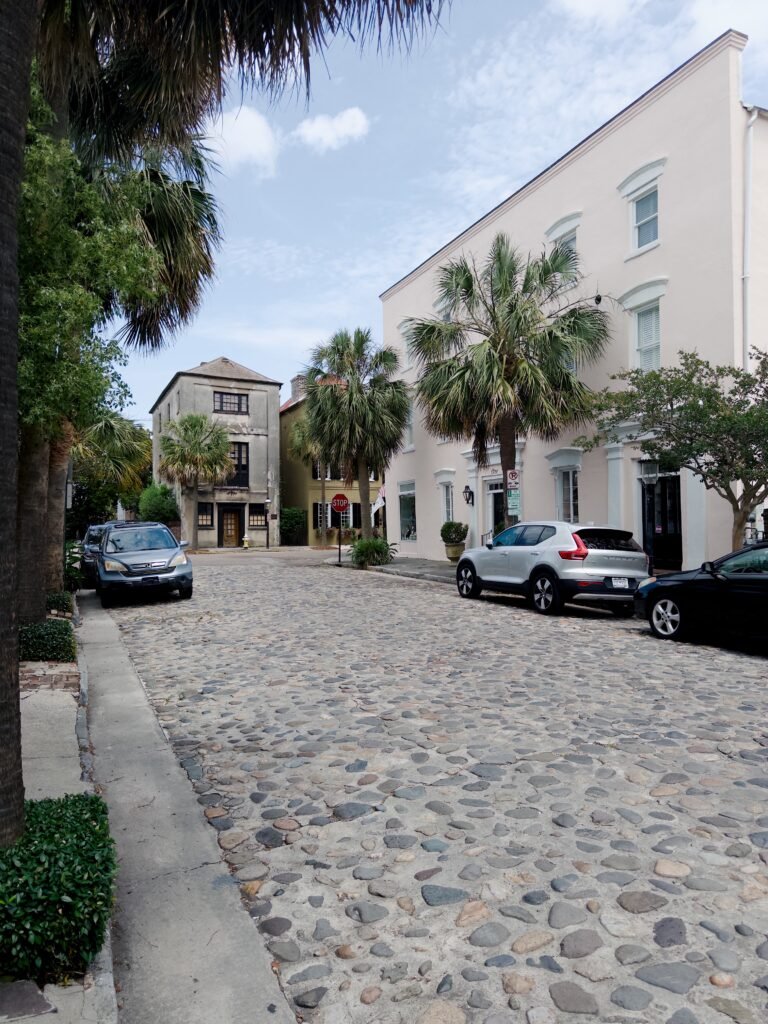
West of King Street, Charleston loosens its collar. Harleston Village is broader and leafier than the lower peninsula’s showpiece districts, with a residential rhythm that feels lived-in rather than curated. Its anchor is Colonial Lake, a rectangular tidal pond ringed by palmettos, oaks, and a promenade that functions as the neighborhood’s shared front yard — joggers in the morning, strollers in the evening, benches facing the water all day.
The architecture here refuses to settle on one era. Formal antebellum homes stand near modest single houses, Victorian-era residences, and institutional buildings in the College of Charleston’s orbit. Queen Street, running between King Street and the lake, still carries traces of the German immigrant community that shaped the area’s middle-class life through the eighteenth and nineteenth centuries. The variety could feel disjointed; instead it’s held together by scale, greenery, and the accumulated patina of history.
Part of the neighborhood’s charm is geographic. King Street’s shops and restaurants are a short walk east, yet Harleston Village never feels consumed by the visitor economy — it stays a place where people water gardens, walk dogs around the lake, and live at a residential tempo just off the city’s busiest artery.
Harleston Village makes a quiet argument that’s easy to miss in the more famous districts: beauty doesn’t require uniformity. A neighborhood can hold two centuries of styles and still feel coherent — as long as the streets stay walkable, the trees stay old, and the buildings keep talking to one another.
4. Ansonborough: A Neighborhood Shaped by Preservation
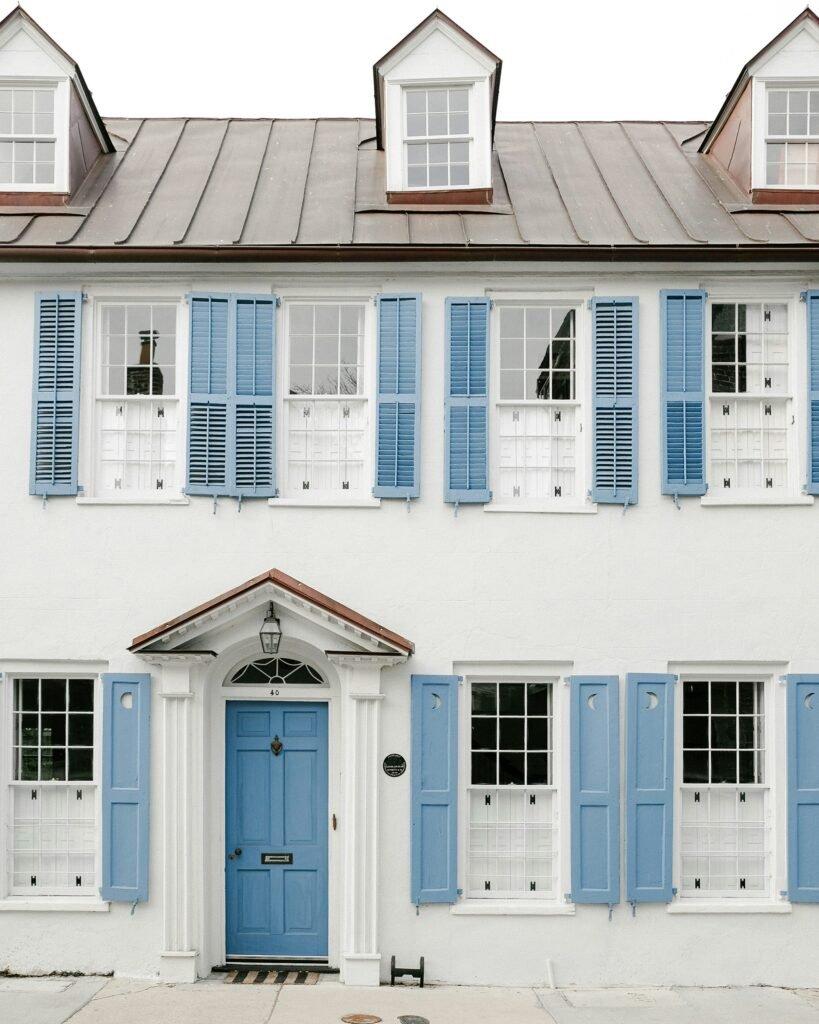
Ansonborough is beautiful because of what was built there — and, just as much, because of what people refused to let disappear. Laid out in the 1740s as one of Charleston’s earliest suburbs, the neighborhood was largely destroyed by the fire of 1838 and rebuilt in the decades that followed, which is why so much of it now reads as a remarkably intact collection of mid-nineteenth-century townhouses and Charleston single houses.
By the mid-twentieth century, much of that fabric had slid into neglect. Beginning in the late 1950s, Historic Charleston Foundation used the country’s first preservation revolving fund to rehabilitate roughly sixty buildings across six blocks. The project became one of the most influential neighborhood-preservation efforts in the United States — proof that a historic district could be revived block by block rather than cleared and replaced.
It is also a more complicated story than the postcard allows. The project drew national praise, but it displaced many of the neighborhood’s predominantly Black, lower-income residents as restored houses returned to the market at prices they could not meet. The preservation succeeded; the community that had lived there did not survive it intact. Both things are true, and Charleston is still working out what that means.
Today Ansonborough’s streets are intimate and immaculate — restored brick, tiered piazzas, gas lanterns, window boxes. If it occasionally feels almost too polished, that tension is part of its story.
Ansonborough is a walkable reminder of something this publication returns to often: beautiful places don’t survive by accident. They survive because people decide — sometimes expensively, sometimes imperfectly — that what already exists is worth keeping. The harder question is who gets to stay once it has been kept.
5. Cannonborough-Elliotborough: Charleston’s Most Layered Beauty
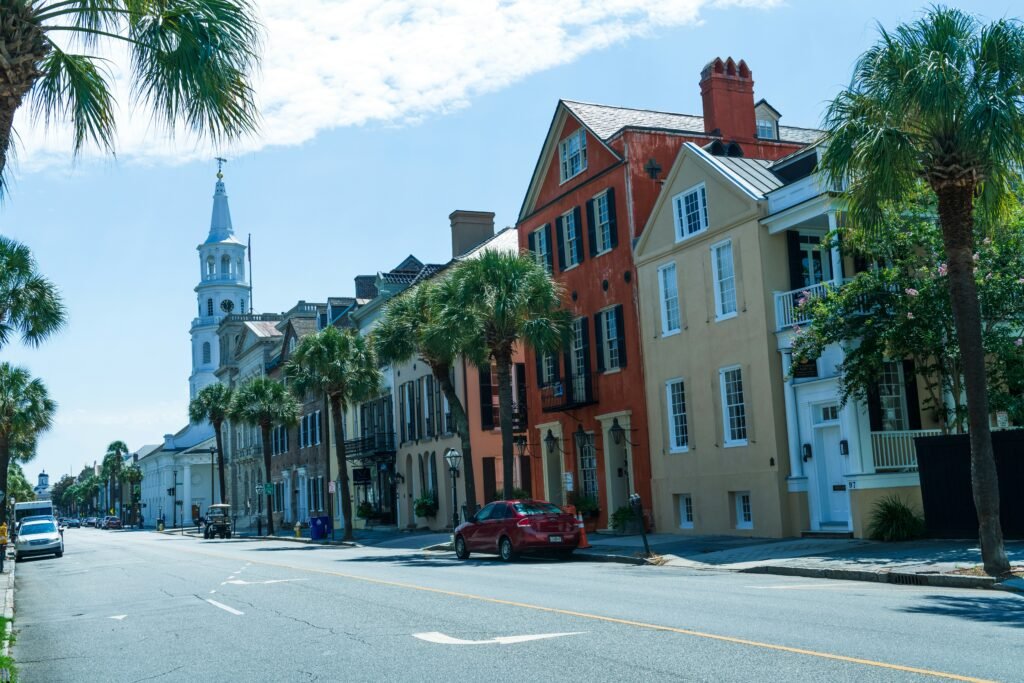
If the lower peninsula shows Charleston at its most composed, Cannonborough-Elliotborough shows the city mid-sentence. These adjoining boroughs above Calhoun Street have long been home to working-class families, immigrants, and a significant African American community whose churches, businesses, and craft traditions shaped the neighborhood’s character — a history that predates, and outlasts, its current run of attention.
Visually, it’s one of the most photogenic parts of the city, in a completely different key: brightly painted Charleston single houses set close together, layered porches, corner storefronts turned cafés and studios — intimacy at cottage scale rather than grandeur at mansion scale. The streets feel occupied rather than preserved: bikes on porches, gardens in progress, paint allowed to fade a little before it’s renewed.
It’s worth being honest about what’s happening here. The neighborhood has absorbed enormous development pressure in recent years, and not every change has been a gain — historic structures have been lost, and rising prices have displaced longtime residents. Its beauty and its complications belong to the same story, and pretending otherwise would flatten what makes the place matter.
Cannonborough-Elliotborough widens the definition this article rests on: “beautiful” should have room for texture, creativity, and human history — not only polished façades.
6. Hampton Park Terrace: Porch Life and Early-Twentieth-Century Charleston
Charleston’s beauty didn’t stop developing in 1860. Hampton Park Terrace, laid out on the upper peninsula between 1911 and 1913, is the proof — a National Register district (listed in 1997) filled with American Foursquares, Prairie-influenced houses, Craftsman bungalows, and Colonial Revival cottages, most of them built between 1914 and 1922. It’s a different architectural vocabulary from the districts downtown, and it produces a noticeably different way of living.
The defining feature is the porch. Deep, shaded, and oriented squarely toward the sidewalk, the porches here aren’t ornamental — they’re furnished, in daily use, and close enough to the street for conversation. The whole neighborhood is scaled to walking: sidewalks under mature trees, houses that greet the street instead of retreating from it, and short blocks that make an evening loop feel effortless. Add Hampton Park itself — sixty acres of lawns, live oaks, and an old rose collection, the largest park on the peninsula — and you get a neighborhood built around the everyday outdoors: walking, waving, sitting, lingering.
Of all Charleston’s neighborhoods, this may be the one with the most to teach about home. You don’t need a landmark house to live this way — you need shade, a seat that faces the world, and a street worth watching. It’s the same principle behind bringing the feeling of a place you love into your own home: atmosphere is rarely about a building’s grandeur, and almost always about how it invites you to spend your hours.
7. Wagener Terrace: Charleston at Its Most Relaxed
Keep going north and Charleston exhales. Wagener Terrace, developed beginning in the 1910s as one of the city’s early planned residential neighborhoods, marks the moment Charleston began — in the gentlest possible way — to become suburban. Brick bungalows and modest historic homes sit on oak-lined streets, the Ashley River glints at the neighborhood’s western edge, and nothing here is trying to be photographed.
That’s precisely its appeal. Wagener Terrace is where Charleston feels most like a place people simply live: porch furniture that’s actually sat in, gardens tended for pleasure rather than presentation, and a tree canopy — some of the best on the peninsula — doing much of the aesthetic heavy lifting. Unlike the districts downtown, the neighborhood doesn’t feel organized around visitors, which is exactly what makes wandering it feel like a small privilege. You’re seeing Charleston off duty, and it holds up.
Wagener Terrace closes the loop on this article’s premise: a memorable neighborhood doesn’t need monumental architecture. Scale, trees, porches, and a sense of belonging can be every bit as powerful as ironwork and piazzas — sometimes more, because they’re the parts you can actually take home.
What Charleston’s Neighborhoods Have in Common
Seven neighborhoods, seven distinct personalities — and yet they are unmistakably one city. Move through them in sequence and a shared grammar starts to surface.
- Buildings stay close to the street, so architecture is part of daily life rather than scenery behind a setback.
- Porches and piazzas blur the line between indoors and out, turning what could be circulation space into living space.
- Mature landscaping softens even the most formal architecture, and brick, stucco, and ironwork are allowed to weather — and get better for it.
- Homes rarely exist in isolation. They respond to their neighbors, their street, and their climate.
None of this survives on its own. Charleston established its Board of Architectural Review in 1931 as part of the country’s first historic zoning ordinance, protecting not just individual buildings but the character of entire streetscapes — which is a large part of why the city still has streetscapes worth protecting.
It’s also why these neighborhoods reward the kind of attention this publication cares about. The qualities that make them beautiful — connection to the street, indoor-outdoor life, natural materials, human scale — aren’t Charleston exclusives. They’re design principles, and they travel.
The Version of Charleston That Stays With You
Charleston’s beauty is often reduced to pastel houses and cobblestones, but that isn’t what stays with people. What stays is the way buildings meet the sidewalk, the gardens that appear behind walls, the porches that make room for conversation — and the fact that seven neighborhoods across the same narrow peninsula can each hold onto a personality of their own. The city doesn’t have one beautiful view. It has dozens, and they don’t repeat.
For the fuller picture — the architecture, the food, the water, and the everyday atmosphere that make the city so hard to leave — continue with the complete guide: Charleston: The Southern Coastal City People Fall in Love With.
Between Pines & Tides is about what beautiful places teach us — and how to carry a little of that into an ordinary week. Join the newsletter below for new destination guides, design notes, and the details worth borrowing.